Tag Archives: Cynthia Bourgeault

Hope: The quality of aliveness in our own backyard

Contemplative prayer is often, even typically, presented in the language of personal healing and self-discovery:
I enter stillness in order to purify my unconscious, heal the emotional wounds of a lifetime, find my true self, and so on.
But there is a natural self-corrective mechanism built right into the prayer itself if we are willing to take it far enough:
my true self is found only in communion with others.
The personal can find its identity only in relation to the whole, which is the mercy of God.
— Cynthia Bourgeault in Mystical Hope

My own backyard

This month I kept running into hope. Sometimes it made me cry.

  • As soon as Pastor Sean began to speak at Algernon Baker’s memorial, I teared up. He insisted we turn into hope, since we knew our brother was ready to wake up into the dawn of his eternity. Then the young adult choir sang the most joyful song I have ever heard.
  • Then I watched my latest episode of Star Trek: Strange New Worlds and felt something good is happening in the world because this moralistic, positive, super-woke show can still manage to get made and appear on the Ellisons’ network.
  • Then, a TikTok  doctor and a new book I am reading reminded me that my grandmother’s attention was one of the ways God reached out to me and undermined the toxic shame we all deal with.

I felt a bit by Dorothy, who has always been strangely central to my theology:

hope
Click the pic if you want to see the scene

We’re often like Dorothy waking up from her vision and realizing her heart’s desire was right under her nose the whole time and among those who love her. What a wonder it is that so many of us are drawn beyond our ordinary awareness and turn away from the death-dealing world to find God “in our own back yard,” so to speak.

Hope is that “quality of aliveness” we feel

As Cynthia Bourgeault ends her book Mystical Hope she tries to sum up her profound teaching about finding hope right under our noses — while rolling down Broad St., even,  and especially in the moments of love we give and receive. She teaches us to find hope in a new way — not as merely an object of our desire, but as the Subject who is as near as the turn of our hearts. I am going to quote quite a bit of it for you:

I have tried to suggest a new way of picturing hope. In this new positioning, the underlying sense of corporateness is physically real, the that “electromagnetic field of love” is the Mercy – and the Mercy is the body of Christ. Through this body hope circulates as a lifeblood. It warms, it fills, it connects, it directs. It is the heart of our own life and the heart of all that lives.

Hope’s home is the innermost point in us, and in all things. It is a quality of aliveness. It does not come at the end, as the feeling that results from a happy outcome. Rather, it lies at the beginning, as a pulse of truth that sends us forth. When our innermost being is attuned to this pulse it will send us forth in hope, regardless of the physical circumstances of our lives. Hope fills us with the strength to stay present, to abide in the flow of the Mercy no matter what outer storms assail us. It is entered always and only through surrender; that is through the willingness to let go of everything we are presently clinging to. And yet when we enter it, it enters us and fills us with its own life – a quiet strength beyond anything we have ever known.

And since that strength is, in fact, a piece of God’s purposiveness coursing like sap through our own being, it will lead us in the right way. It sweeps us along in the greater flow of divine life as God moves – and in the western religions, God does move – toward the fulfillment of divine purpose which is the deeper, more intense, more subtle, more intimate revelation of the heart of God.

Long before we knew Jesus, we had experiences of being swept up in the flow of God’s good purpose — maybe beside a stream like the one above. This “quality of aliveness” was called “righteousness” in the Old Testament, as in Psalm 23: “He restores my soul; he guides me in the paths of righteousness.”

Unfortunately, many people read that couplet as if the psalmist means we will be OK if we stay on the path, within the lines of a moral template so we will succeed at building an ideal replica of God’s kingdom and be justified by it. Far from that egoic reading, the psalmist is reminding us we live in a Spirit-charged “force field” (as we might picture it), a force field in which everything we do must move in order to come to fruit.

The reality of God with us, restoring and guiding us, is much more important than my ability to stay on “the path.” The psalmist is calling the inner (our souls) and the outer (our feet) to sync up, to move with the Great Mover who is giving us life. As our souls are restored and our feet are guided, Jesus says, we become good trees that bear good fruit. As Psalm 1 says, we are then like good trees planted by flowing streams of righteousness.

The quality of aliveness “in Christ”

In the New Testament, Paul calls this territory “in Christ.” In Christ we find that quality of aliveness we were made to enjoy, in which we hope.

To [his saints] God chose to make known how great among the Gentiles are the riches of the glory of this mystery, which is Christ in you, the hope of glory. It is he whom we proclaim, warning everyone and teaching everyone in all wisdom, so that we may present everyone mature in Christ….I want their hearts to be encouraged and united in love, so that they may have all the riches of assured understanding and have the knowledge of God’s mystery, that is, Christ himself, in whom are hidden all the treasures of wisdom and knowledge…As you therefore have received Christ Jesus the Lord, continue to live your lives in him, rooted and built up in him and established in the faith, just as you were taught, abounding in thanksgiving…For in him the whole fullness of deity dwells bodily, and you have come to fullness in him, who is the head of every ruler and authority. – Colossians 1:27-2:10

The phrases “Christ in us” and “us in Christ” are another way to say “moving in the Mercy.” For Bourgeault, the mercy of God is a place of assured understanding, a place of loving  mystery which continues to unfold as we experience it in our hearts. As we are “encouraged and united in love,” Christ in us is the “hope of glory.” In Christ we come to “fullness.”

Paul sounds a lot like Cynthia Bourgeault as she piles up metaphors and viewpoints, circling around the mystical hope she can feel better than describe. Her everyday way to live “in Christ” is meditation that turns her in toward that golden kernel of her true self, protected and saved by God. In a somewhat seamless movement, that everyday prayer then turns her out to write her book, knowing that no self-giving love is wasted in the world, not on her and not on us, either. Our prayer, especially the prayer of meditation, is not only what saves us from the world, it is also the key thing we do to save the world. It is our way to hope, our way to become a people of hope, and our way toward embracing others with hope.

I have enjoyed sharing these five posts inspired by Bourgeault’s book. I’d love to hear how your own prayer was encouraged or developed as a result. Let me know.

More on Mystical Hope
Previous: Mystical hope in a deteriorating world
Swimming in the Mercy: The experience of hope
Anxious and tired: Meditation that turns us toward hope
There is hope: Death will help you enjoy it


There is hope: Death will help you enjoy it

I’m still savoring the memory of Cynthia Bourgeault’s book, Mystical Hope, laying in my lap, a tear trickling down my cheek and a smile broadening across my face in deep relief and joy. I had just reached the part in which she quoted a little piece of a Thomas Merton cassette (!) speaking to his novices.  As I read it, I laughed out loud, since he recalled an image that was very similar to one I had experienced in prayer during a rich period of my thirties — an image that has sustained me ever since.

God is near to us at the point that is just before final destruction. Take away everything else down to that point of final destruction, and the last little bit that’s left before destruction, a little kernel of gold which is the essence of you–and there is God protecting it…And this is something terrific. …[We] don’t normally get into that center unless we’re brought to the edge of what looks like destruction. In other words, we have to be facing the possibility of the destruction of everything else to know this will not be destroyed.

Merton sounds a bit like he is inviting his novices to jump off a spiritual cliff, doesn’t he?! I suppose he is. I suppose I jumped. But he is also inviting relative beginners into a life of prayer, like my three previous posts have been doing. It is a life that leads to the place of surrender and revelation he describes in the quote above. It is a life filled with the mystical hope that does not come through ordinary means.

Meditation “puts us immediately in touch with that ‘little kernel of gold which is the essence of’ us and allows us to begin to recognize it and trust it.” That might be the best feeling in the world.

Unfortunately, your faith journey may not have led you into meditation yet. So much religion these days relies on a “good offense” or a “good defense.” On the one hand, many Christians offer victorious living when they promise an overcoming hope that seems hollow in the cancer ward, or when the baby is born with disabilities, or when the house is destroyed and a lifetime of memories seems washed away. On the other hand the Buddhist track and most of what “mindfulness” is about teaches us an equally deficient  approach when they call us to release our preoccupation with death and suffering in order to experience blissful, mindless oneness with all life.

Deeper than having a good offense or good defense and more in line with the Lord’s example is mystical hope. On the other side of suffering and death is hope. Bourgeault says, “Only if we are still hanging on…only in the measure that we fail to yield completely into the mercy of God, will hope fail us. If we are willing to take it all the way, it will take us all the way.”

Jesus went beyond destruction to hope.

This the journey of yielding completely Jesus took all the way. When he was arrested, he told his disciples to put away their swords because he, like us, needed to pass through his own powerlessness and hopelessness. He purposely did not put his hope in some nuclear arsenal of angels or call on a victory-making God to save him. When he was in the garden praying and meditating (as the disciples fainted), he found that “protecting nearness” at the center of reality. How he went “to the edge of what looks like destruction” is an example for us. It is the Lord’s death as well as his resurrection that is our salvation.

Words on a page don’t work as well as art to explain this basic Christian truth. But this old song gets to it:

O soul, are you weary and troubled?
No light in the darkness you see?
There’s light for a look at the Savior,
And life more abundant and free.
Turn your eyes upon Jesus,
Look full in His wonderful face,
And the things of earth will grow strangely dim,
In the light of His glory and grace.
Through death into life everlasting
He passed, and we follow Him there;

The wonderful old movie, Babette’s Feast, gets at it, too. In this film the wonder centers around a sumptuous meal that reveals many secrets. It is like another last supper, only this one is full of old Danish people facing death. They are gathered full of faith and full of their regrets. The General gets up and names the wonder that is happening among them, the same wonder that was seen when Jesus, the living truth, yielded himself faithfully into the Mercy. The General says, “Mercy and faithfulness have met; justice and peace have embraced.” And all the joys and regrets become one in love as the Alpha and Omega is present in fullness.

There is hope

In our Transhistorical Body blog, we look toward the people who have gone before us for the assurance that this wild thought is true: if I move over the edge of destruction, God will still protect the golden kernel of the true me. If I dare to meet the living God, my old self — my fallen, scarred, angry, abandoned, intolerably vulnerable self, might die, but I will live. We get this assurance not only from our ultimate example, Jesus, but last week we celebrated Claire of Assisi, who could have quoted Albert Camus: “In the middle of winter I discovered in myself an invincible summer.”

There is hope.

I remember a letter to the our old church from a new member. He was telling the church his story before he made a covenant at the Love Feast. He had gone through so much — and went through a lot more, but even now he has hope. He wrote,  “There had always been an emptiness inside me and after my mom passed, I fell into the grips of addiction. When I moved to Philadelphia to get sober, I was fortunate enough to meet Jimmy , in what will always be a “God shot” to me….I was immediately drawn to Circle of Hope and I now realize I was also being called to Christ. This journey brings me joy and deep connection. At times Circle Of Hope is all I felt I had, but the fellowship, my Cell, and my growing relationship with Christ have filled me and helped me to thrive again.”

There is hope.

God is protecting that golden true self at the heart of each of us, calling us to meet in that open-to-the-Spirit place where life moves us and draws us. The everyday way to living comfortably and securely outside our present-oriented injuries and fears and into our eternal now with God is the listening, feeling and releasing prayer of meditation. It seems like a new way, as Bourgeault says, “beyond linear, discursive thinking” into “inspired visionary knowing where Christianity finally becomes fully congruent with its own highest truth and its mystical treasures can be received into an awakened heart.”

If all that beautiful teaching from Merton and Bourgeault seem a bit much to you, just listen to Jesus and see where he leads. Or meditate on Claire of Assisi when you pray. Or appreciate the love that guards the members of the church, even when they have just been called back from far away.

There is hope.

More on Mystical Hope
Previous: Mystical hope in a deteriorating world
Swimming in the Mercy: The experience of hope
Anxious and tired: Meditation that turns us toward hope


Anxious and tired: Meditation that turns us toward hope

The notion that God is absent is the
fundamental illusion of the human condition.
Thomas Keating

“Fundamental illusion” can be a way of life! But it does not have to be that way. Most of the wise people we all admire have a story about how they moved beyond their self-contained understanding to become who they became. Some found a hope deep inside that is vastly better than wishing and waiting for one’s illusions to be validated.

I think the best and deepest way that leads beyond ordinary, self-limited thinking and into hope is the way of meditation. Cynthia Bourgeault, my inspiration for this series, agrees:

Meditation, more than any other spiritual practice, nurtures the latent capacities within us that can perceive and respond to divine hope. In the classic language of our tradition, these capacities are known as the “spiritual senses.”

That little paragraph might have seemed so weird to a few of you, it drove you right back into your egoic thinking! So hang on.

“Egoic thinking” is another way of describing our limited, ordinary awareness. It simply means we humans have the capacity to stand outside ourselves and look at ourselves. As far as we know, we are the only species who can do this. Tigers don’t think, “I have a quick temper.” And whales don’t say, “I am really glad to be going north; I’m a cold-water kind of whale.” And tigers and whales don’t write children’s books where tigers and whales seem cute when they reflect. Humans can imagine these different realities, looking back and forward, dreaming and visioning. It is a great thing about us.

we are drawn to meditation

Egoic thinking is great…until it’s not

The downside of this reflexive capacity, Bourgeault says, “is the tendency to experience one’s personal identity as separate — composed of distinct qualities, defined by what holds one apart from the whole.” We can basically live in “our own little world” (my mother used to say!), revolving around our own sun — ourselves.

As a result of being alone and trapped within the boundaries of our limited senses, we all have a separation anxiety streak running through us because we really need and want to be together, not separate. To feel secure, the ego needs a lot of reassurance from others. It can’t get enough praise, security, accomplishment, etc. to help it overcome that dreadful sense of being left out, or thrown out, or just generally failing to be a full self in community. You can see how quickly we have all been driven into sin by this innate anxiety. And you can see why Jesus calls us to see our true selves in God’s grace, to look at ravens and lilies flourishing, to stop worrying and “seek first for the kingdom of God” as the means of becoming free of what is depriving us of joy.

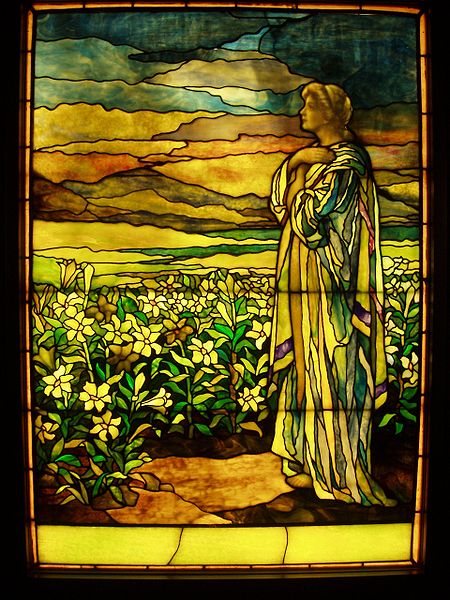
Field of Lilies – Tiffany Studios, c. 1910.

Meditative prayer is a way of discovering and nurturing the latent capacity to see and experience life beyond our ordinary awareness. We can all perceive and respond to “the Mercy” I talked about last week. Nurturing our spiritual awareness is the primary way to experience the “mystical hope” I talked about the week before, the hope which is near and not the outcome of all our striving.

The centering prayer Bourgeault teaches is “a basic, no-nonsense method of self-emptying — simply letting go of thoughts as they arise — to help practitioners break out of their compulsive attachment to thinking and entrust themselves to the deeper stillness of God.” [Here is Martin Laird’s take on it.] The essence of this kind of meditation is not keeping a perfectly clear mind. The essence is recognizing the moment when one is distracted and willingly turning back into the stillness of the Mercy, toward hope. The essence is turning toward the meeting place we have inside as an act of faith and honor; letting go of our own stuff and holding a space open for all God gives and all God is.

We need to get beyond self-awareness and its evil twin: self-centeredness

We have a “self” awareness that is beyond the egoic capacity that makes us human — we also have spiritual awareness. Meditation leads us out of ego-centered consciousness and into a space where we meet God.

You may know almost every other feeling you can have better than the feeling of communion with God! Even so, someone has said we can meet God without even trying by 1) having a near-death experience or by 2) falling deeply in love. I do not wish you the first short cut and I do wish for you the latter. But I wish for us most of all the careful cultivation of meditation, which is the everyday path to knowing and loving God. Meditation is the discipline that helps us “die daily” as Paul says he does, and helps us be one in love as he hopes we will be. The prayer of meditation puts a stick in the spokes of our outer awareness and leads us into the warmth and abundance of our inner awareness and into hope in the Mercy.

It is a hard world right now. Maybe you are pretty numb like a newscaster said she was after covering the damage Trump and Hegseth have done to Iran and to the future of the U.S.  Or maybe you are afraid of more smoke from Canada and the extreme weather of our new climate. If it were not a hard world, we’d probably make it one. So it is time to pray.

Have you listened to Jesus saying this to you lately?

Come to me, all you that are weary and are carrying heavy burdens,
and I will give you rest. 
Take my yoke upon you, and learn from me;
for I am gentle and humble in heart,
and you will find rest for your souls.
For my yoke is easy and my burden is light.

Basic to that easy yoke is the prayer of meditation. We keep turning to it in our anxiety and fatigue and it keeps turning us toward hope. 

Try it again. We certainly fit into the first two lines, for the most part. Maybe his “easy yoke” is meditation where we experience his gentleness and self-giving heart. As a result of staying in that “yoke” maybe we do find rest for our souls.  Sounds like Jesus would love to bring us into the hope he carries, even through his suffering, doesn’t it? 

More on Mystical Hope
Previous: Mystical hope in a deteriorating world
Swimming in the Mercy: The experience of hope

Swimming in the Mercy: The everyday experience of hope

Lynn Bauman’s poetic rendition of Psalm 103:11 warms my heart:

As the heavens reach beyond earth and time,
we swim in mercy as in an endless sea.

I need to hang on to that deeply hopeful picture! Don’t you? Read it again and feel it. May that deep, old biblical truth ascend as new Christian memes lose their strength.

I am longing for sayings like this to descend:

“Only God can turn a mess into a message, a test into a testimony, a trial into a triumph, a victim into a victory.”

And

“I know God has a plan. I pray for direction to follow it, patience to wait on it, and knowledge to know when it comes.”

I don’t think those hopefully-descending proverbs are evil. And I can honestly say they have generally proven true in my life — unlike for many other people I know. But they are more based on outcomes than connection.

I object to the way those cliches reduce hope to something that must be proven. They beg skepticism: “What if the mess does not become a message?” and “We got divorced and it still hurts.” and “I lost my leg in Jordan and I am impoverished as a result.” You may be kinder than I am, but televised stories of trials that turned to triumph often feel a little thin or strained to me. And, what’s more, neglected children learn to turn their trials into triumph because there is no one taking care of them. They only trust themselves, not some parental God. They often spend a lifetime proving they are worth caring about. They hear “turn a trial into a triumph” and there first reaction may be “One more thing to do.”

What’s more, I personally object to the idea that God has a specific “plan” as if she were making sure we get to her preferred outcome: the right job, the safe neighborhood, the healthy family that all “prove” God is good (and us, as a result). Even more, I dread the denial I am called to master in response to terrible outcomes that must be “part of  God’s plan” for me — while Kim Kardashian gets rich. People who have chronic illnesses or some unapproved identity can, indeed, take some comfort that this was somehow God’s plan for them,  but most people don’t have that kind of willpower. Isn’t that why the Barbie theme song was such a hit?

The mercy is not about me

My commitment to wait on the Lord is not the source of my hope. My passionate acts of goodness and faith do not necessarily result in hope. I can’t really manufacture hope. The Lord is my hope.

For God alone my soul waits in silence,
    for my hope is from him. —
Psalm 62:5

Now you’ve read that line. Try waiting in silence for 30 seconds.

Thanks. Now I want to reinforce what the Psalm says. We are not the source of our hope. I  dare not apply my meager sense of what outcome I need in order to have it.

Even though we are not the source of hope, the source is deep within me. It flows to me with unrestrained abundance. It is so endless it would be more accurate to say I am deeply within it. The Mercy is like an ocean.

Maybe we are all like the proverbial little fish who just heard a rumor and swam up to his mother and asked, “Mama, what is water? I have to have it!” We are immersed in mercy like that, the everlasting, living water of hope. We don’t lack hope because we are doing something wrong so it is far away, or because we are waiting for what we expect to be fulfilled some day in the far future and just need to be pateint. We lack hope because it is so close, like air, or like a feeling, such as love. It is more intimate than our own sense of being.

As the heavens reach beyond earth and time,
we swim in mercy as in an endless sea.

Maybe The Mercy is more real than we presently are

Cynthia Bourgeault in her book Mystical Hope, describes the “embodying fullness” in which we live as “the Mercy.” Mercy is the water in which we swim. Mercy is what we know of God and the light by which we know it.

I adopted “Mercy” as my main prayer when I got used to the Jesus prayer: “Jesus Christ, Son of God, have mercy on me, a sinner.” As I was riding my bike through town, avoiding car doors, potholes and pedestrians, I realized one day that the curses rising up in me, which added to my frustration and sense of alienation, could be replaced with a one-word prayer that turned me toward my center, toward a realization that I was still in the water, still swimming. Now I am likely to face a distressing or even hope-draining moment with “Mercy!” So much better.

Bourgeault explains “the Mercy” so beautifully:

When we think of mercy, we should be thinking first and foremost of a bond, an infallible link of love that holds the created and uncreated realms together. The mercy of God does not come and go, granted to some and refused to others. Why? Because it is unconditional – always there, underlying everything. It is literally the force that holds everything in existence, the gravitational field in which we live and move and have our being.

Just like that young fish looking for water, we “’swim in mercy as in an endless sea.’ Mercy is God’s innermost being turned outward to sustain the visible and created world in unbreakable love.” We see that so clearly as Jesus turns himself out on the cross and God turns creation inside out to return him to life.

The interpreters of the work of Christ keep looking for words to describe what they experience. Paul says:

Hope does not disappoint us, because God’s love has been poured into our hearts through the Holy Spirit that has been given to us. — Romans 5:5

The basic work of the Christian ends up being a quest for the “water,” for an everyday, moment by moment experience of The Mercy.

It only sounds easy

Preachers often get up front and give the congregation a lesson in CBT: how to change you mind and thought patterns to get a Christian outcome. Some people get the lessons and many others get the shame of never effecting the perfect outcome. Either way, we are kind of in charge of making our own hope or responsible for the lack of it. The Jesus way is much deeper than what we can already do, if we just try hard enough.

If the narrow way of living in mystical hope were easy, we’d all be hopeful. It isn’t easy, but it is possible. The more we experience it, the more we get used to our true selves. Instead of living in a world run by scientific principles waiting to be proven again, or worse, a nobody-in-charge universe run by whoever manages to get into power, we become aware that we are “inside a warm-hearted and purposive intelligence, a coherence” of which we are part of the expression. We live in the creation of the Mercy.

Instead of God as a distant “other” we are restored to God as our “source and substance, the ground of our own arising, the foundation of our hope.” I want to talk more about how we might experience this reality in the coming weeks, since, for me, once experienced, it is undeniable and irreplaceable — and we really need it these days.

As I wrote that sentence, I was on hold with Citibank, which bought my credit card from Barclay’s, which did not process a fraudulent purchase for $15K (!!) before they unloaded me. Then Citi did not follow up after I called them. Now i was starting over a month later! Welcome to 2026. The climate-change-induced storm last week left a log from a dead tree in my back yard. The brazenly-corrupt Donald Trump is still president and desperate to undermine the elections which people think are their only hope.  Yes. I am turning into my irreplaceable source of hope as I write. It feels good. The turn is energizing. God is my hope.

So for now, I will leave you in hope. Whatever energy you exercise striving for some outcome you hope for would be better used for turning in to hope and swimming for joy in the Mercy. Then, when whatever outcomes emerge, miraculous or not, you can swim right up to them.

[Part One of this series: Mystical hope in a deteriorating world.]

*******

Today is Flannery O’Connor Day! Get to know her and her wild God at The Transhistorical Body.

Mystical hope in a deteriorating world

We founded my former church, Circle of Hope, in a ripe moment of history and the outcome was beautiful. Then it wasn’t. And then Eliza Griswold wrote a book about how badly it all turned out that sealed its legacy through her lens. It made some of her reviewers weep.

When it all started in 1995, we sat in a small circle discussing what our name would be. We ended up with several versions of a name with “hope” in it. But some people did not like any of those versions. A few people (and in a circle of ten, a few is relevant!) thought it was just too much to put “hope” right out there in the church’s name.

Barack copied us?

Maybe they were right to be cautious. Regardless, they were certainly representative of many others, since many people think hope is far-fetched, even dangerous — mainly because they think it is something tied to outcome. If you are a “circle of hope” you invite expectations that might not be met.

So many people are laboring under all the “outcomes” required of them, and under all the “outcomes” they were promised which never came to fruit.

For many people, “hope” is an optimistic feeling — or at least a willingness to go on, because they sense things are going to get better. But is that sense about worn out  these days? What if you put “hope” right out there on your poster, like President Obama did, and then everything does not get better like you promised? Instead, there are drones, recession and bailouts. What if your church implies that Jesus is going to get you a job, provide a mate and cure your cancer and those things don’t happen? Won’t the name of your church just point out the fact that it did not happen? For some people, hoping just makes you look naive, at best, and like just another gaslighter, at worst.

We had a few people on our little team whose hopes had been dashed. What’s more, some of them had grown up in the church, where they even memorized Bible verses like in Psalm 116: “I love the Lord, because he has heard the voice of my supplication…I was brought very low and he helped me.” But their lives had not worked out just like the verse seemed to promise, empiricistettes as they were.

After a while, it is hard to figure out what to do with dashed hopes. Sometimes they are like a secret you would not disclose among people who still hope for some bright future.

I have memorized some Bible verses myself and I am an optimistic guy — and God has repeatedly helped me when I was “brought low.” Even so, I have never thought it was wise to make promises God was not going to keep, at least was not wise to act as if God were the Amazon of human want.

Another way of experiencing hope

The Bible does, indeed, promise God will meet our needs. But if you look deeper, it teaches that the promise is deeper than just meeting our expectations. I am re-reading a little book that beautifully points out there is another kind of hope represented in the Bible which is a complete reversal of our usual way of looking at hope in terms of outcomes. We can see that hope in Habakkuk 3:17-19 where the prophet dances on the heights even though the land is devastated, and we can see it when Jesus offers inside water for outwardly thirsty people in John 4:13-14, and we can see it in the “total immersion course” in the school of hope that the book of Job is where he ends up singing Job 19:25-26: “I know my redeemer lives.”

Cynthia Bourgeault calls this deeper hope “mystical hope” — and that is the title of her book, too. Mystical hope has three characteristics in contrast to our usual notions of hope. These usual notions, based on outcomes, are not bad, they just aren’t complete or entirely useful. She says, in light of the three biblical examples I just mentioned:

  • Mystical hope is not tied to a good outcome, to the future. It lives a life of its own, seemingly without reference to external circumstances and conditions.
  • This kind of hope has something to do with presence – not a future good outcome, but the immediate experience of being met, held in communion, by someone intimately at hand.
  • This hope bears fruit within us at the psychological level in the sensations of strength, joy , and satisfaction: and “unbearable lightness of being.” But mysteriously, rather than deriving these gifts from outward expectations being met, it produces them from within.

Our mystical hope

I think we had enough mystical hope when were were planting a church to work for good outcomes even when people thought they were not good enough. We came to know our existence was resistance. Our assessment of our value and impact did not define our worth.

But maintaining that view our ourselves was hard. We were just discovering the seismic shifts among the youth of the nation (our focus demographic) which experts have been talking about ever since. For instance, one week in 2017 our pastors passed around a couple of pieces that tested our hope. One was from the Census Bureau.

The map above shows the increase in the number of young adults (18-34) in the United States living at home with their parents in 2015 compared to 2005. The changes in that decade, and certainly the last preceding 40 years were staggering. More than 1 in 3 young people lived in their parents’ home in 2015. That was a huge increase in one decade. What’s more, of those people, 1 in 4 were idle; that is, they neither went to school or worked. Many people saw that reality as a poor outcome. Were all these people hopeless? Ten years later many of the men in the study are the incels of the manosphere.

The other piece the pastors passed around was about alone and lonely men. A journalist who researched psychology was pondering the horrible Las Vegas shooting. An apparently completely alone man was the shooter. As a “lone wolf” he was not that unusual among men. The author says:

As a man, you might be thinking, “Not me, I’ve got drinking buddies. I play poker with the guys. I’ve got friends.”

But do you have confidants? Do you have male friends who you can actually be vulnerable with? Do you have friends whom you can confide in, be 100% yourself around, that you can hug without saying “No homo,” without feeling tense or uncomfortable while you’re doing it?

For many men, the answer is “no.” So, we spend our time posturing instead.

From an early age, we have an unhealthy ideal of masculinity that we try to live up to. Part of that ideal tells us that Real men do everything on their ownReal men don’t cry. Real men express anger through violence.

The byproduct is isolation. Most men spend the majority of their adult lives without deeper friendships, or any real sense of community. Not to mention a complete inability to release anger or sadness in a healthy way.

Many woman feel exactly the same way, of course. And the evil ways of late capitalism have made a perfect environment to create unhealthy, isolated people — A.I. is just making it worse. I experience the outcomes all the time. Some days it just feels hopeless.

There is something other than bad outcomes

I want to say more about Cynthia Bourgeault’s book in the coming weeks. But for now, let me end with a quote from the early pages of Mystical Hope which talk back to twentysomethings who feel their future is bleak, and call to parents who feel their children are hopeless cases, and whisper to men and women who feel isolated and friendless, stuck in some pattern which feels hopeless. There is something deeper than your situation. Jesus has a promise that is better than you expect.

You’ll need to read her little book to get the full effect and all the references, but maybe you can get a taste from these lines:

  • Hope is not intended to be an extraordinary infusion, but an abiding state of being. We lose sight of the invitation – and in fact , our responsibility, as stewards of creation – to develop a conscious and permanent connection to the wellspring. We miss the call to become a vessel, to become a chalice into which this divine energy can pour; a lamp through which it can shine.
  • But what if we are intended to become this vessel, this body of hope? What if, in fact, this effervescent, “lightness-of-being” energy is the fuel that drives our human life toward its divine fulfillment? What if our insistence on treating it as a rare and exceptional phenomenon is a way of ducking the invitation that was permanently extended at the Samaritan well that blazing midday?
  • The journey to the wellspring, the to secret of Jesus, the Master of Galilee, is the great inner journey to which we Christians are called.

I am glad we put hope right out there in the name of our expression of the Church back in the day. It dared people not to meet Jesus. On the one hand, God produced outcomes that were MUCH greater than we imagined as we sat in a little circle of ten in our living room. We hoped good things would happen and even more than we hoped happened. So that’s great. But what about all that did not happen? What about when it all fell apart 20+ years later? What sustained us when we failed, broke up, died, lost faith, were betrayed and confused?

It is always that mystical hope, that turning toward the living water which energizes us to get up and live in joy as we follow Jesus through what is next.

 [As you can tell, this is the first in a set of updates of 2017 posts. They seem even  more important now than when I first wrote them.]

*******************

Today is Pantaleon Day! The martyr who gave away his wealth and doctored the poor for free. He used to be wildly famous, as a result. Meet him at The Transhistorical Body.

Moving into the third level of awareness in everyday life

I went to a large memorial service recently. It was full of stories and very moving because the woman being remembered was influential and beloved. I went because she prayed for me.

When we first landed in Philadelphia to plant a church, I knew we were likely to fail if we did not call on gifted people to pray for us. I collected scores of people to intercede who got a regular letter listing our triumphs and trials. Grace Holland was among the first to join in. Whenever I saw her she told me how she was praying and often had a question about something in our letter that intrigued her. She might not have known how much that meant to me; and she might not have really cared, since praying was a reward in itself for her.

Grace’s family is so full of faith and the wildness missionary kids often carry it would have been hard not to have an interesting and spiritually-stimulating morning at the memorial they held. I had a wonderful time. In fact, I have kept mentalizing about it, which led me to write this post.

As a person who has led many meetings for stories, teaching, ceremony and worship, I know members of an audience are not having a singular experience. At any given moment, someone is receiving what is offered with their ordinary awareness, perhaps exclusively. Others will be experiencing it with their spiritual awareness. Still others are blessed in their deepest hearts with an awareness of the presence of God.

Thomas  Keating, the main instigator in the Centering Prayer movement which got rolling in the 1970s, drew a simple target graphic to explain his common-sense description of what is happening when we turn toward God. I have been re-reading Cynthia Bourgeault’s classic expansion on his chart in Centering Prayer and Inner Awakening.

Ordinary awareness

Some people who attended the funeral probably experienced it entirely with their ordinary awareness. They might have been children. They could have been a distant relation or acquaintance unfamiliar with the family or their brand of Christianity and were caught up with the curiosity of it all. Or they may have been spiritually undeveloped due to lack of opportunity or resistance. People with childhood trauma or children of parents who did not nurture a secure attachment often find it difficult to connect with other people or God and spend much of their time feeling so responsible for their well-being they can’t do anything else.

Ordinary awareness is the reflexive consciousness that only humans have, as far as we know. I have several pictures of a son staring at his fist as a baby coming to the realization he is a separate being from his mother. We all have the capacity to stand outside ourselves and look upon ourselves in the third person. We come to know ourselves as distinct from others with attributes and gifts that need to be expressed to “be ourselves.”

So I experienced the funeral with my ordinary awareness. For instance, I thought I had left with plenty of time to spare after the long drive from Philly to Harrisburg. But I actually just made it to the memorial in time, since the turnpike was jammed due to a car having caught fire. We saw it melted on the shoulder with its poor owners watching the firemen mop up. The feelings stuck with me. Then I entered a large meeting room with quite a few people I had not seen for years and a few I did not want to see. My “monkey mind” was hopping.

At any given moment our awareness is full of stimulating things coming at us which often  stimulate things we have stored up: random thoughts, memories, associations and sensations. We get “triggered,” we like to say, and habitual reactions may lead to a chain reaction that can set off our anxiety. If we did not have that sense of “self” that can step back and see what is going on, we might not be able to endure the chaos. That self-reflexive “I” is probing and measuring the universe all day, and even when we dream it asks things like, “How am I doing?” “Is it safe here?”  “What did she mean by that?” “Am I OK?”

Bourgeault says, “Another name for ‘ordinary awareness’ is ‘egoic thinking.’ It is the normal functioning zone of the human mind. It doesn’t matter whether you’re a Ph.D., a bishop, a nuclear physicist; how brilliantly intellectual or intensely devout you may be. Without spiritual training, your sense of the world and your sense of yourself will be formed at this level of awareness. Even the so-called self-awareness tools of our times, from psychotherapy to Meyers-Briggs  personality typing to the enneagram, spend most of their effort merely resorting and clarifying the characteristics: ‘I am an INFP,’ ‘a gut-centered type,’ ‘a five,’ etc. This may add insights into the workings of the personality, but it’s till ordinary awareness.

Spiritual awareness

The funeral lasted about two hours. So there was a lot of opportunity for ordinary awareness. Plus I had to catch up with some old friends which occupied my mind and heart with pleasantries and tragedies.

Thinking together about our experience afterward, my wife and I realized that shortly after we arrived we had already soaked up the emotion swirling around the room, as a psychologist and psychotherapist might be prone to do. We were primed to be moved beyond our ordinary awareness and into our spiritual awareness. Grace was a well-known worshiper, so a time for that was  included. Almost with the first note, both of us began to cry. And we were drawn beyond ourselves.

As the worship continued, it would have been hard to miss the experience of spiritual awareness all humans are equipped to have whether someone was a Jesus follower of not. The meeting was like a first glimpse of Yosemite Valley, which seems to make everyone pause with awe. I first experienced such wonder under the stars in the Anza-Borrego desert. You may have felt it during a beautiful fall sunset last week. At times I have been drawn in when my friends were dancing or we were meeting an emergency together. And, of course, babies have been born.

Bourgeault says “spiritual awareness is actually a way of perceiving, just as ordinary awareness is a way of perceiving. As with ordinary awareness, there is a sense of identity or selfhood generated through this mode of perception. The big difference between them is that whereas ordinary awareness perceives through self-reflective consciousness, which splits the world into subject and object;  spiritual awareness perceives through an intuitive grasp of the whole and an innate sense of belonging. It’s something like sounding the note G on the piano and instantly hearing the D and the B that surround it and make it a chord. And since spiritual awareness is perception based on harmony, the sense of selfhood arising out of it is not plagued by that sense of isolation and anxiety that dominates life at the ordinary level of awareness.“

Holy Spirit awareness.

I was delighted with the smorgasbord of spiritual food we shared with Grace Holland’s family. I think she would have loved it – even the parts she thought we not fully baked yet. She would have loved how the meeting regularly veered into a thin place where we could reach into the bull’s-eye of the target, the goal Father Keating called our “divine awareness.”

The moment in the meeting I remember most, and these moments are usually relatively fleeting for all of us, was when we sang one of Grace’s favorite songs. Her son, Mike, recounted it was a tune that might pop into her ordinary awareness and lead her beyond it at any moment. I have also been moved by it since Maranatha Music released it on Praise 4 in 1980: “I Love you Lord.”

The song arose in the late 1970’s when it tumbled out during Laurie Klein’s quiet time before her toddler woke up. It found its way to Jack Hayford’s Church on the Way in Van Nuys, California, which I visited. It was recorded by several musicians in the budding Christian music scene, including 2nd Chapter of Acts, who I followed. It gained general  recognition when Maranatha! Music published it and now Korean choirs sing it, too.

As we sang it, I felt the presence of God course through my body. I was one with God, with those gathered and with everyone who has sang that song throughout my life and throughout the world. I enjoy remembering that experience.

We all have a place at the center of us where our own being and God’s being are mysteriously interwoven, even if we are not aware of it. Bourgeault says, “The divine indwelling is the cornerstone of contemplative prayer. Thomas Keating refers to it as ‘our personal big bang,’ for it reveals the Source of our own being – the explosion of divine love into form which first gave rise to our personal life. It also reveals the direction our heart must travel for a constantly renewed intimacy with this Source. As we enter contemplative prayer, we draw near the wellspring from which our being flows.“

The whole world is full of glory

The big, noisy funeral I attended did not have much silence at all. Maybe I will leave that as a request for own funeral. But I carried a silent place with me as I attended which has been formed by years of attention to God-with-us. We meet God deep within us and all around us. It is beautiful when a song flows out of your personal, private quiet time. But the whole earth is full of the glory of God. We meet God-with-us wherever we go. We can’t make an appointment, per se, but we can expect that glory to erupt into our awareness.

Bourgeault points out that ordinary awareness and spiritual awareness are both necessary for functioning in this world. “But the idea in spiritual transformation is to integrate and reprioritize these levels so that our ordinary awareness is in alignment with and in service to our spiritual awareness (which in turn, as we have seen, is in service to the divine awareness). In that alignment our being flows rightly, from innermost out. When something needs to be done in the outer world, we have sufficient ego strength to do it. But unlike ordinary awareness, which is always doing things to assert itself or fulfill itself, action grounded in our spiritual awareness merely flows out of the divine abundance without regard to outcome or any need to draw attention to itself.”

To hear her family and pastors talk about her, the heart of God and Grace’s own heart were in a deep embrace at the center of her and much of her action flowed from that abundant life. I took that away as a lesson. But more so, I experienced its legacy at her funeral and joined with her in the eternal life of it.

Take the time: Grow in the good soil of God’s garden

“All liberating growth takes time.” That’s what Paul Tournier, the Swiss physician and counselor, taught us in one of his many great books, Creative Suffering (1981).

Most of my clients initially see this truth as bad news. One reason is they are paying for therapy, so  a long road to liberation could cost them a lot of money! But the main reason the long process is hard to endure is they can taste the first fruit of freedom and they want it all right now. They regret their time lost on immaturity. It feels like bad news to be reminded it takes time to heal; it takes time to learn and install new habits. I often describe the process of growing into our fullness as creating new “ruts” in the brain as we climb out of the old ones. Both adding the new and filling in the old takes time. This video explains the science of the process.

It is always the right time to grow

The fact that it takes time to experience liberation is actually good news, I think. Whenever I am growing, I am right on time! I may feel like I am late, but I am never too early! If we can let go of our linear, progress-dominated, capitalism-inspired sense of success, the time spent on liberation can come to feel like growth. It can feel free, like growing is our top priority, just like we see in plants as they move from seedling to plant, to flower, to fruit. They have nothing to do but grow.

The Apostle Paul reinforces how we have been restored to our natural growth process in Ephesians 4 when he describes how the gifts of the Holy Spirit we all contribute build up the body of Christ. The Spirit keeps moving in us

until all of us come to the unity of the faith and of the knowledge of the Son of God, to maturity, to the measure of the full stature of Christ…We must grow up in every way into him who is the head. (NRSV)

It feels good to be at home as the “plants” we are, growing in the soil of God’s love. That sense of innate capacity for becoming more is a taste of eternity. I’m fine if it takes as long as it takes.  Becoming whole can take as long as I live to complete – I have eternal life! It is not a defeat or an imposition to need maturity! It is a joy that comes with our birthright as the children of God to grow into fullness. Even if it is a struggle to change, growing is a good suffering.

VIDA E MORTE DE JESUS MAFA
Jesus, Gardener of the New Creation

Rut-making prayer

God calls us and coaxes us into our potential in many ways. I know of several men who recently had amazing dreams that convinced them they are loved and worthy. During the day they are prone to proving themselves and working extra hard to be successful and to be valued as a result, they hope. But during the silence of their sleep, their defenses weaken and God meets them. They are always trying to figure out how to get their dreamlife into their schedule!

God, the Healer, meets us in our spiritual awareness but also in the ordinary awareness that often dominates our consciousness and our schedule. That ordinary awareness forms ruts in our brain, the familiar pathways we began learning as infants. But we have a spiritual awareness that leads us in deeper ways that often feel miraculous.  As we intentionally become silent (or listen to our dreams) our receptivity opens us to face the unknown places we have yet to visit in Christ, both in God and in ourselves. It takes time! It is also daunting because it is sometimes frightening to leave our familiar neural pathways, to “unknow” our past and move into new territory in the Spirit, which feels like a place of “unknowing.”

I appreciate how Cynthia Bourgeault explores the process of maturing in her book Centering Prayer and Inner Awakening (2004) as she is quoting Thomas Keating’s book Intimacy with God (1996).

Beginning in infancy (or even before) each of us, in response to our perceived threats to our well-being, develops a false self: a set of protective behaviors driven at root by a sense of need and lack. The essence of the false self is driven, addictive energy, consisting of tremendous emotional investment in compensatory ”emotional programmes for happiness,” as Keating calls them…

It is the false self we bring to the spiritual journey, our “true self” lies buried beneath the accretions and defenses. In all of us there is a huge amount of healing that has to take place before our deep and authentic quest for union with God – which requires tremendous courage and inner presence to sustain – escapes the gravitational pull of our psychological woundedness and self-justification. This, in essence constitutes the spiritual journey.

All liberating growth takes time. Jesus has replanted us in the good soil of his “garden.” We don’t need to fret if we discover we are a seedling. We can enjoy the growing. We are planted in grace, after all. That is enough in itself.

I think the “garden” where our true self grows is accessed best through contemplative prayer. If you want to grow faster, spend more time in silence, listening and feeling your way into your rightful place as the beloved of God. Our false self may flourish in the family, job and religion. But that false self withers in prayer, since is it the nature of contemplative prayer to dissolve it.

I mentioned three books today, any one of them would help you mature. I hope we all grow deeper ruts in which our true selves can flow by cooperating with the Great Healer. Jesus will lead us through the pain of transformation and the joy of growing – no matter how long it takes. We have time.

Hope: The quality of aliveness right under our noses

Last Saturday, I kept running into hope and it made me cry.

  • As I rolled in to the Good Business Oversight Team summit, Pie Jesus came on my player right when I was thinking about the epidemic of heroin-induced deaths in our city and country. My grief over the loss of hope among the victims (and now their families!) made me a dangerous, vision-impaired driver!
  • Then I went to the Love Feast and felt the worship team and the covenant-makers stoking our hope as they expressed theirs – we were, in fact, a Circle of Hope. It made me weep with joy.
  • Before we went to bed, we tuned into Netflix and watched the last episode of season six of the most Christian TV show ever: Call the Midwife. The sweetness of their hope in the middle of a changing world and troubling family situations unleashed my own hope – and the tears.
hope
Click the pic if you want to see the scene

What a wonder it is that so many of us are drawn away and turn away from the death-dealing world and find God “right under our noses” so to speak. We’re often like Dorothy waking up from her vision and realizing her heart’s desire was in her own backyard all the time and among those who love her.

As Cynthia Bourgeault ends her book Mystical Hope she tries to sum up her profound teaching about finding hope right under our noses, while rolling down Washington Ave, and especially in the moments of love we give and receive. She is teaching us to find hope in a new way, not as an object of desire, but as the subject who is as near as a turn of heart. I am going to quote quite a bit of it for you:

“I have tried to suggest a new way of picturing hope. In this new positioning, the underlying sense of corporateness is physically real, the that ‘electromagnetic field of love’ is the Mercy – and the Mercy is the body of Christ. Through this body hope circulates as a lifeblood. It warms, it fills, it connects, it directs. It is the heart of our own life and the heart of all that lives.

Hope’s home is the innermost point in us, and in all things. It is a quality of aliveness. It does not come at the end, as the feeling that results from a happy outcome. Rather, it lies at the beginning, as a pulse of truth that sends us forth. When our innermost being is attuned to this pulse it will send us forth in hope, regardless of the physical circumstances of our lives. Hope fills us with the strength to stay present, to abide in the flow of the Mercy no matter what outer storms assail us. It is entered always and only through surrender; that is through the willingness to let go of everything we are presently clinging to. And yet when we enter it, it enters us and fills us with its own life – a quiet strength beyond anything we have ever known.

And since that strength is, in fact, a piece of God’s purposiveness coursing like sap through our own being, it will lead us in the right way. It sweeps us along in the greater flow of divine life as God moves – and in the western religions, God does move – toward the fulfillment of divine purpose which is the deeper, more intense, more subtle, more intimate revelation of the heart of God.”

Nature tree autumn river moss wallpaper | 2048x1365 | 166584 | WallpaperUPLong before we know Jesus, we have had experiences of being swept up in the flow of God’s good purpose. This “quality of aliveness” was called “righteousness” in the Old Testament, as in Psalm 23: “He restores my soul; he guides me in the paths of righteousness.” Unlike how many people read that couplet, the psalmist did not mean we should stay within the lines of a moral template so we will succeed at building an ideal replica of God’s kingdom and be justified by it. The poet was reminding us we live in a Spirit-charged “force field” (as we might picture it), a force field in which everything we do must move in order to come to fruit. The inner and outer need to sync up: our souls are restored and our feet are guided; as Jesus says, we become good trees that bear good fruit; as Psalm 1 says, we are good trees planted by flowing streams of righteousness.
In the New Testament, Paul calls this territory “in Christ.” In Christ we find that quality of aliveness we need.

To [his saints] God chose to make known how great among the Gentiles are the riches of the glory of this mystery, which is Christ in you, the hope of glory. It is he whom we proclaim, warning everyone and teaching everyone in all wisdom, so that we may present everyone mature in Christ….I want their hearts to be encouraged and united in love, so that they may have all the riches of assured understanding and have the knowledge of God’s mystery, that is, Christ himself, in whom are hidden all the treasures of wisdom and knowledge…As you therefore have received Christ Jesus the Lord, continue to live your lives in him, rooted and built up in him and established in the faith, just as you were taught, abounding in thanksgiving…For in him the whole fullness of deity dwells bodily, and you have come to fullness in him, who is the head of every ruler and authority. – Colossians 1:27-2:10

“Christ in us” and “us in Christ” is the Mercy, that place of assured understanding, that mystery that continues to unfold as we experience it in our hearts “encouraged and united in love.” Christ in us is the “hope of glory.” In Christ we come to “fullness.”

Paul sounds a lot like Cynthia Bourgeault as she piles up metaphors and viewpoints, circling in on the mystical hope she can feel better than describe. Her everyday way to “in Christ” is meditation that turns her in toward that golden kernel of her true self, protected and saved by God. In a somewhat seamless movement, that everyday prayer then turned her out to write her book, knowing that no self-giving love is wasted in the world, not on her and not on us, either. Our prayer, especially the prayer of meditation, is not only what saves us from the world, it is also the key thing we do to save the world. It is our way to hope, our way to become a circle of hope, and our way toward encircling others with hope.

I have enjoyed sharing these five posts inspired by Bourgeault’s book. I’d love to hear how your own prayer was encouraged or developed as a result. Let me know. If you missed one, I think you can find them all by searching for “Cynthia Bourgeault” with the search bar.

More on Mystical Hope
Previous: Mystical hope in a deteriorating world
Swimming in the Mercy: The experience of hope
Anxious and tired: Prayer that turns us toward hope
There is hope: But you’ll need to die to enjoy it

Subscribe to Development! Hit the “follow” button after you type in your email. Thanks for reading!

There is hope: But you’ll need to die to enjoy it

I’m still savoring the memory of Cynthia Bourgeault’s book, Mystical Hope, laying in my lap, a tear trickling down my cheek and a smile broadening across my face in deep relief and joy. I had just reached the part in which she quoted a little piece of a Thomas Merton cassette (!) speaking to his novices.  As I read it, I laughed out loud, since he used an image that was very similar to one I had received in prayer during a rich period of my thirties — an image that has sustained me ever since.

“God is near to us at the point that is just before final destruction. Take away everything else down to that point of final destruction, and the last little bit that’s left before destruction, a little kernel of gold which is the essence of you–and there is God protecting it…And this is something terrific. …[We] don’t normally get into that center unless we’re brought to the edge of what looks like destruction. In other words, we have to be facing the possibility of the destruction of everything else to know this will not be destroyed.”

Merton sounds a bit like he is inviting his novices to jump off a cliff, doesn’t he?! And I suppose he is. I suppose I jumped. But he is also inviting relative beginners into a life of prayer, like my three previous posts have been doing. It is a life that leads to the place of surrender and revelation he describes in the quote above.

Meditation “puts us immediately in touch with that ‘little kernel of gold which is the essence of’ us and allows us to begin to recognize it and trust it.” So much religion these days relies on a “good offense” or a “good defense.” On the one hand we are taught to release our preoccupation with death and suffering in order to experience blissful, mindless oneness with all life. Then on the other hand, many Christians offer something equally deficient when they promise an overcoming hope that seems hollow in the cancer ward, or when the baby is born with disabilities, or when the house is destroyed and a lifetime of memories seems washed away. Deeper than having a good defense or good offense  and more in line with the Lord’s example, on the other side of suffering is hope. Bourgeault says, “Only if we are still hanging on…only in the measure that we fail to yield completely into the mercy of God, will hope fail us. If we are willing to take it all the way, it will take us all the way.”

Jesus went beyond destruction to hope.

Isn’t this the journey Jesus took all the way? When he was arrested he told his disciples to put away their swords because he, like us, needed to pass through his own powerlessness and hopelessness. He was not going to hope in some nuclear arsenal of angels or call on a victory-making God. When he was in the garden praying and meditating (as the disciples fainted), he found that “protecting nearness” at the center of reality. How he went “to the edge of what looks like destruction” is an example for us. It is the Lord’s death as well as his resurrection that is our salvation.

In the wonderful old movie Babette’s Feast, the wonder centers around a sumptuous meal that reveals many secrets. It is like another last supper, only this one is full of old Danish people facing death, gathered full of faith and full of their regrets. The General gets up and names the wonder that is happening among them, the same wonder that is seen when Jesus, the living truth, yields himself faithfully into the Mercy. The General says, “Mercy and faithfulness have met; justice and peace have embraced.” And all the joys and regrets become one in love as the Alpha and Omega is present in fullness.

There is hope

On All Saints Day, we look toward the people who have gone before us for the assurance that this wild thought is true: if I move over the edge of destruction, God will still protect the golden kernel of the true me. If I dare to meet the living God, my fallen, scarred, angry, abandoned, intolerably vulnerable self, my old self might die, but I will live. We get this assurance not only from our ultimate example, Jesus, but last week we celebrated Rosa Parks, who could have quoted Albert Camus: “In the middle of winter I discovered in myself an invincible summer.”

There is hope.

Or look much closer; look at Mike Escott’s covenant blog from the love feast last Saturday. He has gone through so much and is going through much right into life, right now:  “There had always been an emptiness inside me and after my mom passed, I fell into the grips of addiction. When I moved to Philadelphia to get sober, I was fortunate enough to meet Jimmy , in what will always be a “God shot” to me….I was immediately drawn to Circle of Hope and I now realize I was also being called to Christ. This journey brings me joy and deep connection. At times Circle Of Hope is all I felt I had, but the fellowship, my Cell, and my growing relationship with Christ have filled me and helped me to thrive again.”

There is hope.

God is protecting that golden true self at the heart of each of us, calling us to meet in that Spirit-open place where life moves us and draws us. The everyday way to living comfortably and securely outside our present-oriented injuries and fears and into our eternal now with God is the listening, feeling and releasing prayer of meditation. It is a new way, as Bourgeault says, “beyond linear, discursive thinking” into “inspired visionary knowing where Christianity finally becomes fully congruent with its own highest truth and its mystical treasures can be received into an awakened heart.”

If all that beautiful teaching from Merton and Bourgeault seem a bit much to you, just listen to Jesus and see where he leads. Or meditate on Rosa Parks when you pray. Or appreciate the love that guards Mike, even when he has just been called back from far away.

There is hope.

More on Mystical Hope
Previous: Mystical hope in a deteriorating world
Swimming in the Mercy: The experience of hope
Anxious and tired: Prayer that turns us toward hope
Next: Hope: The quality of aliveness right under our noses

Subscribe to Development! Hit the “follow” button after you type in your email. Thanks for reading!

Anxious and tired: Prayer that turns us toward hope

The notion that God is absent is the
fundamental illusion of the human condition.
Thomas Keating

If Cynthia Bourgeault is right (and my own experience says she is), then the way beyond egoic thinking is the way of meditation. She says, “Meditation, more than any other spiritual practice, nurtures the latent capacities within us that can perceive and respond to divine hope. In the classic language of our tradition, these capacities are known as the ‘spiritual senses.'”

That little paragraph might have seemed so weird it drove you right back into you egoic thinking! So hang on. All “egoic thinking” means is we humans have the capacity to stand outside ourselves and look at ourselves. As far as we know, we are the only species who can do this. Tigers don’t think, “I have a quick temper.” And whales don’t say, “I am really glad to be going north; I’m a cold-water kind of whale.” And tigers and whales don’t write children’s books where tigers  and whales seem cute when they reflect. Humans can imagine these different realities, looking back and forward, dreaming and visioning. It is a great thing about us.

we are drawn to meditation

Egoic thinking is great…until it’s not

The downside of this reflexive capacity, Bourgeault says, “is the tendency to experience one’s personal identity as separate — composed of distinct qualities, defined by what holds one apart from the whole.” So we all have an anxiety streak running through us because we really need and want to be together, not separate. The ego can’t get enough: praise, security, accomplishment, etc. to overcome that dreadful sense of being left out or thrown out and failing at being a full self. You can see how quickly we have all been driven into sin by this innate anxiety. And you can see why Jesus calls us to see our true selves, look at ravens and lilies, stop worrying and “strive first for the kingdom of God and his righteousness” as the means of becoming free of what is depriving us of joy.

Art often captures the turning of meditation
Field of Lilies – Tiffany Studios, c. 1910.

Meditative prayer is a way of discovering and nurturing the latent capacities within us that can perceive and respond to “the Mercy” I talked about last week. It is a primary way to experience the “mystical hope”I talked about the week before, the hope which is near and not the outcome of all our striving.  The centering prayer that Bourgeault teaches is “a basic, no-nonsense method of self-emptying — simply letting go of thoughts as they arise — to help practitioners break out of their compulsive attachment to thinking and entrust themselves to the deeper stillness of God.” [Here is Martin Laird’s take on it.] The essence of this kind of meditation is not keeping a perfectly clear mind. The essence is recognizing the moment when one is distracted and willingly turning back into the stillness of the Mercy, toward hope; turning toward the meeting place we have inside as an act of faith and honor; letting go of our own stuff and holding a space open for all God gives and all God is.

We need to get beyond self-awareness and its evil twin: self-centeredness

We have a “self” awareness that is beyond the egoic capacity that makes us human — we also have spiritual awareness. Meditation leads us out of ego-centered consciousness and into a space where we meet God. And so many of us know almost every feeling better than the feeling of communion with God! Someone has said we can also get to this meeting place by having a near-death experience or by falling deeply in love. I do not wish you the first short cut and do wish for you the latter. Meditation is the everyday path. It is the discipline that helps us “die daily” as Paul says he does, and helps us be one in love as he hopes we will be. The prayer of meditation puts a stick in the spokes of our outer awareness and leads us into the warmth and abundance of our inner awareness and into hope in the Mercy.

It is a hard world right now. Maybe you are pretty numb like a newscaster was saying she was after she was confronted with Donald Trump’s and General Kelly’s icky relationship with the family of La David Johnson. Or maybe you are feeling like the pastor who wrote to Christianity Today to voice how tired he is of trying to get into the white man’s church and how determined to separate into a black world until someone approaches him for once. If it were not a hard world, we’d probably make it one. So it is time to pray.

Have you listened to Jesus saying this to you lately?

“Come to me, all you that are weary and are carrying heavy burdens,
and I will give you rest. 
Take my yoke upon you, and learn from me;
for I am gentle and humble in heart,
and you will find rest for your souls.”

Basic to that easy yoke is the prayer of meditation. We keep turning to it in our anxiety and fatigue and it keeps turning us toward hope.

More on Mystical Hope
Previous: Mystical hope in a deteriorating world
Swimming in the Mercy: The experience of hope
Next: There is hope: But you’ll need to die to enjoy it
Hope: The quality of aliveness right under our noses

Subscribe to DevelopmentHit the “follow” button after you type in your email. Thanks for reading!